Friday, November 28, 2003

More Than Words For Snow

Ever hear that Eskimos have scores of words for snow? Apparently it's a myth [1], as their language has around the same number of words for snow as English does (snow, sleet, powder, slush, etc).

Whether language shapes and influences perception and thought is a hotly debated issue, and while I do think it does, I don't think it does so in the same ways as it is typically considered by people on either side of this argument.

The Eskimo words for snow are often cited as evidence of language as a shaper of perception and thought, and revealing it as a myth is often used as evidence that language does not shape thought. Another example I've heard concerns the fact that one language may have a term for a particular concept, while there may not be a way to directly express that concept in other languages.

Even if any of these were true, I think they would at most provide pretty weak evidence. And I'd say the same for the other 'evidence' I've heard -- I don't think they really capture the ways that language really does influence perception and thought. I'm not saying that no one has any strong examples, just that I haven't seen any -- in what I've read on the web, in magazines and in books [2] -- and certainly not in any of the popular discussions of this issue.

I want to present an example that illustrates a way I think language does influence thought, and fairly significantly influence it. The setting is as follows. There's a research group in a university computing department who have a novel idea for a piece of computer security software. The idea itself is quite general, and could be applied in a number of situations, and what they're currently looking to do is find some commercial interest that would allow them to pilot the system in a more concrete setting.

They are in a design meeting where they are trying to put together requirements for the system, as a starting point for any potential commercialisation. One member of the team is at the whiteboard, where he's written up two colomns, one saying 'needs to have' and the other 'wants to have'. These coloumns are referring to features the software could have -- and how critical the team thinks they are.

After these colomns have been drawn up on the board, one member of the team interjects that perhaps there could be multiple sets of 'needs to have' and multiple sets of 'wants to have'. The person at the whiteboard turns to the person and with a look of incredulity asks how there could be multiple set of 'needs to have'.

He goes on to say: if the software needs to have a feature, then it goes under 'needs to have' and if it doesn't need to have the feature, then the feature has to be something that we want the system to have or something we don't want the system to have -- there's no other possibility!

And regardless of how watertight that argument may sound, it's wrong. There can be multiple, different sets of 'need to have' because what features are critical (need to have) depends on the context the system will be applied in. As was mentioned earlier, the idea behind the software is quite general, and could be applied in a number of situations. The particular situation may influence which features the system needs to have, and which are merely desirable.

So if the argument was wrong, how can it sound convincing? Well, it's basically because the argument was based on the meaning of the words 'need to have' rather than on a consideration of the situation that those words were being applied to. If you just consider those words you have to conclude that you either need to have something or you don't need it, and that there's no two ways about it.

Essentially, the mistaken argument arised from putting words before reality. That is, thinking of the words first, then trying to think of the reality in terms of those words. We can see the truth by considering the reality first, then considering the words we're concerned with in terms of that reality. This means realising that we're considering features of the system, then thinking that the possible set of features will depend on what setting the ideas are applied to, and that thus 'need to know' depends on the setting.

I'll stop there. Perhaps I haven't made the strongest case for why langauge strongly influences thought in this fashion. Though I've seen a number of other examples of this nature in the past, other examples aren't things I can come up with from memory, so I'll be on the look out for more examples in the future - watch this space. Another thing I'd like to get into someday, hopefully soon, is why I think people tend to put words first. I think there is a very general mechanism at work in our minds that gives rise to this way of thinking -- and much else. Anyway, I've had enough for tonight -- I'm tired and my lower back is killing me sitting here on the chair. Mumble mumble, grumble grumble, bah humbug :-).


[1] See, for example, here and here.
[2] I'm afraid that I haven't kept notes on what I've read, but I can recall Stephen Pinker's The Language Instinct and that there were some articles in New Scientist.

Wednesday, November 26, 2003

New Hope for Heart Disease

You might have seen this news already -- it's from earlier this month -- but I thought it's still worth posting: [paraphrased] Researchers have discovered a treatment involving good cholesterol that, for the first time, appears to significantly reverse heart disease (ABCNews).

Tuesday, November 25, 2003

The Razor Wire Looking Glass

Greg Egan has written a great piece overviewing Australia's detention of Asylum Seekers. Nicely written and informative.

Here's the first part:

Port Hedland is a sleepy, sun-drenched town, 1300 kilometres north of Perth. Early in September I travelled there for the fifth time, a year on from my first visit.

Each time I return it's as if I've never been away. The tranquil streets and cloudless sky must seem idyllic to someone in the right frame of mind, but whenever the heat and silence start to lull me into a pleasant daze, I remember the words of one of my friends who lives here all year round. He had trouble sleeping, he told me, because his room felt like the grave. For him, the sense of being stranded, untouched by time, isn't restful at all. It's exactly like being buried alive.

The immigration detention centre lies at the eastern end of town. The former BHP single men's quarters, now enclosed by a high fence topped with razor wire, is surrounded by ordinary buildings: a library, a school, a recreation club. This facility is known officially as a "reception and processing" centre, but there hasn't been much reception or processing going on here for a while. These days it's more like a human warehouse. Nearly everyone here has been locked up for close to three years, and many for more than four.

Four years without freedom is a long sentence in anyone's language. Some people who tell their families back home that they're still in detention after all this time are simply not believed. "Did you rob a bank?" they're asked. "Did you kill someone?" How could anyone be imprisoned for so long, just for crossing a border to ask for asylum?

There are people here who began their incarceration at the age of four, at nineteen, at twenty-six, at thirty-four. The ordinary possibilities of childhood, youth, marriage, and parenthood have either been lost to them completely, or distorted beyond recognition. There is no stage in life when a loss like this can be borne without damage; you might as well try to remove a pound of flesh without spilling a drop of blood. Worse, immigration detention does not mean serving a fixed term, with days you can count off with mathematical certainty. The sentence is open-ended.

Everyone here has been told by the government that it's safe for them to return to their homelands. Of eight Afghanis I know who've gone back, unable to bear detention any longer, six found the situation so perilous that they had to flee again. People returning to other countries have been arrested at the airport and imprisoned without charge or trial. In at least three cases documented by church groups, rejected asylum seekers returning from Australia have been murdered. That's the choice we're offering people: be delivered into the hands of your enemy, or stay here and rot in prison.

It's hard to imagine just how corrosive that kind of stress must be. Many people here are on antidepressants and sedatives. Many have been driven to self-harm. But even those who aren't plainly psychologically ill are exhausted, debilitated, by the impossible situation they're facing.

Friday, November 21, 2003

Language in Perception and Thought: Misleading Metaphor for Nanotech

When people talk about nanotechnology machines, particularly self-replicating nanotech, they often invoke biological metaphors, such as biological cells and their self-replication.

These metaphors can be misleading, however, as -- the article claims -- "artificial replicating systems [...] are going to bear about as much resemblance to the biological variety as, say, a 747 bears to a duck".

These metaphors may be causing unnecessary concerns about some of the dangers associated with nanotech.

Thoughts in Few Words (2)

Societies have habits called traditions.

Quote on Perception and Making Breakthroughs

 
The difference between making a breakthrough and not can often be just a small element of perception
     -- Brian Greene


This line is from an interview in Sentific American, entitled "The Future of String Theory -- A Conversation with Brian Greene". Brian Greene is a physicist and author. The line comes from the following paragraph:

To me that suggests what a fundamental discovery is. The universe in a sense guides us toward truths, because those truths are the things that govern what we see. If we're all being governed by what we see, we're all being steered in the same direction. Therefore, the difference between making a breakthrough and not often can be just a small element of perception, either true perception or mathematical perception, that puts things together in a different way.

Saturday, November 15, 2003

Thoughts in Few Words (1)

What greatness has been stifled by this world? The vast majority, I'd say, for everyday, in subtle and overt ways, unknown potential is oppressed. A potential I think is carried by most of us.

Friday, November 07, 2003

Round, Round, Round We Go

Can you imagine someone dictating a memo onto a tape and then mailing that tape overseas and waiting for it to be mailed back so they can listen to it, before continuing with their composition? Sound ridiculous? Why would anything so here-and-now and connected to the author involve such an extravagant interposition?

In a lot of ways, that scenario is actually pretty similar to what's going on as I'm writing these weblog posts. As I'm writing the post with my browser pointed at Blogger's editing page, I like to keep another window open showing my weblog's page, so I can see what I've written in a nicer rendered HTML than the small, cramped up text shown in the editing page.

So I type away for a bit, click on 'post and publish' -- at which point my text gets sent from my browser here in Australia to (I presume) some server in the US -- then I reload the rendered display of the post in the other browser window -- whereby the text of the post gets sent back from the US.

This round-the-world routine only takes a few seconds to complete, and I do it frequently, without giving it a thought. But imagine how ridiculous this scenario would have seemed to someone, say, 15 years ago! Who in their right mind would even think about doing that?!

A point that I think can be made is that small details can be significant -- in this case the insignificant cost and time of sending that data back and forth -- and that we tend to assume that only the large details count, with everything else being roughly in line with what we'd expect with the large details being as they are -- that large distances involve large times and costs.

One place where we are prone to making this mistake is when we consider our future. With any issue, such as transportation, health or technology, we assume that the details that aren't mentioned will stay the same as they are today.

Thursday, November 06, 2003

Opinions Aren't Always Just Opinions

Everyone has opinions, but we alone own ours. To a certain extent they define who we are, and while not all of our opinions are dear to us -- so far I haven't fought anyone to the death over my view that green is a nice colour -- some of them obviously are.

Not only do we hold certain opinions strongly, but we strongly believe in their sanctity. When I express my opinion it's not the same as me expressing a fact about the world, I'm just saying what I feel. How could anyone dispute my opinion - it is just my opinion!

Nobody would argue with that, except that right now I want to suggest that things aren't always so simple and it's not always completely true that opinions are beyond criticism.

One reason is that what gets passed off as 'opinion' is quite often not really an opinion. The ostensible meaning of 'opinion' is 'simply what I feel'. I'll call this 'pure' version of opinion. In the pure version, you've got things like "I like it, because it has qualities that are, purely in my subjective opinion, good". In the common version of opinion you're saying: "I like it because it's good". Often statements of opinion are veiled claims of fact.

But that still leaves the 'pure' version of opinion intact. What about some teenager who's really into one style of music, and who honestly doesn't like the sound of any other kind of music? This might be their honest and sincere opinion. They just don't like the sound of other kinds of music.

Is there anyway someone could be critical of this opinion? I want to suggest that there might be, though this will depend on certain details of that situation being the case. But before I explain, I just want to make clear that being critical doesn't necessarily mean being nasty or attacking someone.

OK, imagine if the person has never really tried listening to any other kind of music other than their favourite, and thus haven't had a chance to get used to another kind of music in its own terms? Perhaps their opinion is based more on lack of exposure than anything else? I think this is a reasonable way to be critical of an opinion - to be critical of its foundations.

There's a prevalent, though unstated, belief which is probably going to sound a bit strange when I say it: that opinions don't come from anywhere; they just are. Under this view, criticising an opinion is a bit like criticising the colour blue. You can't do it, because it's type of thing, like a colour, which the notion of criticism can't apply to.

But that view doesn't stand up to close examination. There's always something behind an opinion, some reason you feel that way. The reason doesn't have be a consciously chosen one, nor does it have to be significant, but this doesn't change the fact that it exists. I didn't choose to like the colour green, but no doubt my like of it arises from the structure of my brain or its chemistry, or perhaps it has to do with associations I made with the colour when I was younger.

And if we trace things back, we might discover things that we might not consider so reasonable. Should we consider that person's opinion to be just as reasonable as a well-informed one, with it being the result of not being informed? Or a more in-your-face case: should we consider someone's racist opinions expressing dislike for certain skin colours just as reasonable as anybody else's opinions on the matter?

There's another reason why opinions are more than "just opinions". They have a real impact on the world. Obviously, if someone holds an opinion, then this can effect their actions. If I like green then I might be inclined to buy a green t-shirt. While it is self-evidently true that opinions have consequences, people often talk about them as if they don't.

In Australia you'd have a hard time arguing that the average person's high-level of devotion to sport is a bad thing. You'd be told that it's just their opinion, that they're free to like what they want. That assumes that there are no consequences of them holding that opinion.

Consider this, then: we all have a limited amount of time, and time spent on one thing means less time for other things. Devotion to one thing can lead to underexposure to other things, things like making yourself informed about the way the world works, and the way things are at the moment -- remembering here that an intelligent, informed populous is important for successful democracy.

Or think about how the exultation of sporting heroes comes at the expense of exposure to other, perhaps more worthy, types of people. Anyway, I don't want to get bogged down in the details of arguing this point, but I hope I've gotten the basic point across - that opinions have an impact, for better or worse, on the world outside our heads.

At this point I'm going to try summarising things. There are three main points. First, though we tend to consider opinions to be opinions in the pure sense ("I like this movie"), most opinions are really expressions of what we think is really the case ("I think this movie is good"), that is, claims of fact. Second, I believe we can criticise the foundation of an opinion, even a pure opinion, and that by doing so, we may be able to say that it is less, or more, reasonable than other people's opinions on the topic. And finally, while it is often presumed that people are free to have opinions because that's just their own personal thing, free from any connection with the outer world, opinions can and do have an impact on the world and others.

So there you have it, my take on why opinions aren't always "just opinions". I can easily imagine some people reading this post and -- boom boom -- saying "yeah, but that's just your opinion". I just thought I'd get in first :-).

Sunday, November 02, 2003

Quote on Opinions and Facts

 
We are each entitled to our own opinion, but no one is entitled to his own facts
     -- Patrick Moynihan


I came across this quote while doing some rambling browsing. I saw a reference to the Wayback Machine, which archives the web, and decided to take a look at it. Through that, I ended up looking up the earliest archived page for Slashdot, from back in 1997 -- and this quote was the one they had on the bottom of that page.

Wednesday, October 29, 2003

A Book in the Hand, and New Eyes for its Complexity

A change of perspective gives rise to an intuitive image of dazziling complexity

Think of some piece of sculpture, real or imagined, it doesn't matter. Visualise it, see its shapes, its curves, its lines, its angles. How could the complexity of such a work be expressed? How could it be measured? I have no idea what the answer is, but I'd expect that a major part of it would involve the complexity of its shape. Perhaps mathmatical tools of topology could be used to give some fairly objective measure of it, for example. Hold that thought.

Now imagine you have a book in your hand, again any book will do. We can also think about a book's complexity. This is something which has no doubt been done by various people, and I imagine that issues such as the complexity of the writing, the plot and the characters are common parts of such attempts. The other day it occurred to me a very different conception of a book's complexity. I'm not saying it's a better way, but it is quite different, and I think it is quite provocative.

It's really quite simple, you look at its shape. Turn it around in your hands and you'll see it's a prism. Open it up and look inside and you see what really makes up the book, the words. This change of perspective reveals a dazzlingly complex construction: the intricate shape of a letter, appearing in each of the book's letters, chained one after the other, in an edifice spanning thousands and thousands. This, the combined shape of each and every letter stretching from page one to the end, is the shape of the book.

Friday, October 24, 2003

Book Review: The Curious Cook

The Curious Cook: Taking the Lid Off Kitchen Facts and Fallacies, Harold McGee, 1990.

There's a kind of spectrum of tasks, at one end of which are those things you learn by doing, and the other end those things you learn by studying. We might learn history in books, but our knowledge of cooking is, by and large, firmly placed over the kitchen stove.

It's not hard to see why. Over many generations and millennia, people have figured out what works and what doesn't. In a continuing cycle, most of us learn from a parent or relative or from some cookbook, in a process of imitation, which gives way to an intuitive understanding of what works and what doesn't, and on and on from generation to generation.

Our understanding of cooking is on an intuitive, functional level. We can understand that adding a bit of salt will enhance the flavours, and we know roughly how much salt is required to do this - and how much would make the dish unpalatable. Which seems fair, for if we were to get an understanding at the next level down, we'd be getting into the realms of chemistry. And at this level, things get pretty damn complex!

It would seem that you'd have to know a hell of a lot about the chemistry, the structure of the cooking materials, how they combine and interact in the process of cooking in order to improve upon the millennia of trial and error experience and incremental improvement!

It is in this context that Harold McGee's "The Curious Cook", aimed at the lay reader, successfully brings to bear some understanding of underlying science onto various matters food. The result of this rare combination is interesting, informative and a pleasure to read - and it shows that a deeper understanding can sometimes be very useful. McGee not only knows his science, he also knows how to write in a clear and entertaining manner.

The book is organised as a collection of essays split over three sections. The first covers some kitchen experimentation to uncover the truth behind some kitchen lore, and to troubleshoot some common problems, such as how to keep salads green and fresh. The second looks at matters of health, covering the role of food in heart disease and cancer, and what part aluminum might play in Alzheimer's. The third entails some miscellaneous reflections relating to science and food.

In the first section we learn such things as why searing meat doesn't really seal in the juices, why bleurre blanc is so simple yet other similar sauces are so complex, a simple way of making mayonnaise, and simple formulas for getting the right proportions of ingredients for making various different types of water ices (something that you won't be able to find elsewhere).

As you've probably sensed from that list, the range of topics he covers is fairly eclectic, and, speaking as someone who's more interested in Indian and Asian cooking, it's also oriented towards European food. But even so, it's fascinating stuff, and a lot of it reads more like a mystery novel than a science text or cookbook. He'll have a promising lead, go down the path of exploring it, only to discover it was a red herring, and off he'll go on another lead.

One thing I found quite surprising was how wrong certain kitchen lore was, and how easy it was for him to systematically check it out using a simple kitchen set up (as opposed to an industrial lab and equipment). Like searing meat to seal in the juices - it makes intuitive sense, but if you actually check it out, it doesn't make any difference at all. Yet it's common lore that's been handed down and accepted from generation to generation. The only benefit seems to be that the searing helps to initially brown the meat.

The second section moves from food and cooking to its effects on our health. Specifically, he covers heart disease, cancer, and the potential link between aluminum and Alzheimer's. I'm a bit squeamish about these kinds of things, but I actually found these chapters more interesting than anything else. It's fascinating, and at the same time kinda mellowing, to realise that heart disease and cancer are more the result of imperfections in our body's functioning than anything else - for example, most carcinogens are do not themselves cause cancer, but are turned into things which cause cancer by our own bodies.

Most popular treatments of these issues often talk in very simplified and vague terms, and I thought this section really helped you understand the issues by giving you an account of what's actually going on in the body. In particular, the description of heart disease was very nicely written.

While he attempts to summarise the current scientific understanding of these matters, it's worth noting that the book is close to 15 years now, and I wonder how much things have moved on since then. In any case, I expect the understanding of the fundamentals he presents is unlikely to be much changed.

The third and final section is a scattered collection of three essays related to science and food. The first two are historical in nature, one talking about Brillat Savarin (remembered for a handful of epigrams, such as "Tell me what you eat, and I will tell you what you are"), who was one of the first to foray into the world of food and science, and the other chronicling the history of the substance Osmazome, which people once thought contained the essence of the flavour of meat. The final essay reports recent research findings that shed light on why we find the flavours of cooked food so desirable (while most animals, and indeed our predecessors, don't).

Entertaining, practical, informative and unique - The Curious Cook is well worth a look.

Home Laser Engraver/Etcher


The VersaLaser is basically a PC printer that allows you to engrave and etch designs onto wood, plastics, leather, stone and other materials. It uses a powerful laser, which can also cut through various materials (Article; Pics/Specs; Discussion). Apparently, similar laser-based systems have been around for a while, but not as a PC peripheral. One will set you back about $10 000 (US, I assume). Futher encroaching of the world of information onto the world of atoms.

Today's Comics

Monty - Night Vision Goggles, not bad
(Others: Pearls Before Swine, Dilbert, Get Fuzzy, Herman, Speed Bump, Strange Brew)

Thursday, October 23, 2003

A Nice bit 'a UI Innovation

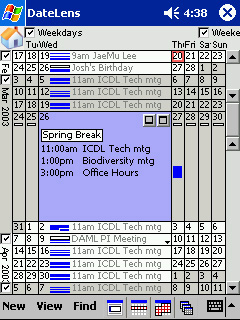
screenshot

DateLens is a piece of Calendar Software with a very interesting focus + context, zoomable user-interface (Details and flash-based demo).

The basic view is a grid, with each cell representing a day. You can zoom in on a particular day, whereby that cell will enlarge and, to give it more space, the surrounding cells will contract a little. The zooming is smooth and works in a progressive fashion: you can go from a small cell for the day, to a summarised view, to the full details. I haven’t tried it myself, but the interface looks quite natural and flowing.

Tuesday, October 21, 2003

Idea for Web-browser feature: Highlighting Equivalent Links

Here's a simple idea that could provide a minor enhancement to the web-browsing experience. If there's more than one link on the visible portion of a page pointing to the same target, then when the user mouse-overs one of those links, have the browser highlight the rest of them. This way, the user can be alerted to the fact that they all point to the same place. As far as I know, there aren't any browsers that implement this and I'm not aware of anyone having tried it - but then I hardly keep close track on these matters.

It's not uncommon for a webpage to contain multiple equivalent links. Links on the site's navigation side-bar can also appear with in the body of the page. Or the page may simple reference the same document in multiple contexts; sometimes these links may point to different parts of that document. For example, a page on the university site may make repeated references to the university's as policies outlined on a particular page. Or certain links from within the body of the page may be distilled as references at the end of an article.

That all these links point to the same place may not be clear, however. The link text may not be the same on all links, for one thing. (In Internet Explorer, if you open one of the links in a new browser window it gets marked as read but the other equivalent links stay the same until you refresh the page, but this issue would be best remidied by immediately marking them all as read).

Even if the link text is the same for all the links, it won't necessarily be obvious that they're all pointing to the same page. I've had a number of experiences like the following. You might have seen a link in one paragraph and decided not to follow based on its link text and the context. Then, a minute and a few paragraphs later, you see another link and click it, because it this context it seems interesting or useful - only to realise that it's the same one you didn't want to visit earlier.

Because you were like most readers and didn't devote a heap of attention to the target of each link you mouse over, you forgot that the two links were the same. Memory is made more difficult by non-mnemonic URLs that are hard to read let alone remember. If the relationship was shown by the browser, I think this mistake would be harder to make.

If pages were written well, the destinations of links would be clear, and this problem wouldn't help provide justification for such a feature. But often they're not, and tools such as well browsers should be designed to best support the realities of the task they're facilitating.

I think it'd be interesting to try this idea out and see how it flys. It looks like it'd be easy to implement, and aside from it potential usefulness, I think there are other reasons it might fly: it's an incremental, evolutionary addition to the browsing toolkit, and it requires no overhead or change of habits to use. I also don't think it'd be too distracting, nor too confusing to inexperienced users.

Unfortunately I've got too many things I'm pursuing that are higher-priority for me than learning enough about a browser to have a go at implementing this. So if anyone is interested in giving it a go, please let me know how it went.


There's a lot more I'd like to say about this feature, because I think there are a few other situations it'd be useful in, and I'd like to go a little deeper into the underlying reasons why it's useful (or at least seems so to me). There's also some more sophisticated ways this could be implemented (so you can see all the equivalent links on the page, not just those that are currently visible), and I think the technique that could be used to do this would be useful in a number of contexts. There's just not the time at the moment :-), so I'll have to deal with these matters later...

Updating the food pyramid

The well known food pyramid, offering simple prescriptions for a good diet, is now just over ten years old. Scientific American have an article from earlier this year on what we've learnt about dietry health in the intervening years. It's both fortunate and unfortunate that, as the title of the article ("Rebuilding the Food Pyramid") suggest, we've learnt a fair bit more. Unfortunate, because better health will require changes in habits and established lore, but fortunate, because it ought to help bring us closer to that goal.

Songs that've got me right now.

At any time, there's always a few songs that make me want to crank the radio up when they come on.

I really like that new Outkast song, "Hey Ya!". It's got a great upbeat, funky energy to it, and for some reason it sounds to me refreshingly un-run-of-the-mill. When I listen to it, I get the impression that the guy doing the vocals has a real intimate familiarity with how to use his fairly unique voice: the tone, emphasis and timing combine brilliantly and there's a real smoothness and confidence in the vocal delivery. There's some nice lines, too: "ladies.... give me some sugar, I am your neighbour" and "Shake it, shake it, shake it, shake it, shake it like a Poloroid Picture".

The other one that's got me at the moment is "That Great Love Sound" by The Ravonette's (listen to a sample, at Amazon.co.uk). It's well-crafted guitar-rock/pop, and definitely worth checking out. I love the bit when the female vocals echo the "makes me want to scream and shout" (or perhaps 'sing and shout', I can't remember) line.

Monday, October 13, 2003

Friday, October 10, 2003

An interesting future for TV

Director of BBC New Media & Technology on the what the future holds for tv (PaidContent.org). Increased user control, localised content, more user input, ambient tv, programme sharing... and sooner than you might think. The article seems pretty insightful.