Wednesday, October 25, 2006

Daniel Dennett's policy recommendation

Advice Goddess Blog writes:

"Dennett’s one policy recommendation –- education on world religions (for kids):
Education on world religions for /all/ our children,

in public and private schools, and home schooling
Dennett explained:

Toxic religions depend on enforced ignorance of the young –- and a religon that can flourish in an informed (citizenry) is a benign religion.

Malcolm Gladwell: unfamiliar- and expert- tasks are harder than you'd think

Malcolm Gladwell argues that outsiders tend to underestimate the difficulty involved unfamiliar tasks, especially those involving expertise.

Tuesday, October 24, 2006

Favourite Recipes: Milanese-style Osso Buco

Milanese-style Osso Buco

This is adapted from an Antionio Carluccio cookbook (can't recall which, though the recipe is on pg 130 of it).

It's richly flavoured, and is much better after a reheat when the flavours have integrated fully.

Osso Buco[1] are cross sections cut from veal leg bones. So they're disc-shapes, a few centemeters thick, with meat surrounding the central bone. He reccomends getting a butcher to cut the pieces "from the middle of the skin where the bone is rounded on both sides and the meat is dense".

  • osso buco (veal marrow-bone), 4 x 4cm thick pieces
  • seasoned plain flour, for dusting
  • olive oil, 4 tbsp
  • small onion, 1, diced
  • peeled roma tomatoes, 800g can, strained of half their juices
  • juice of 1 large orange, and finely grated rind of ½ orange
  • dry red wine, 150ml
  • salt and pepper to taste
  • Gremolata
    • flat-leaf parsley, finely chopped, 4 tbsp
    • finely grated lemon zest, 1 tbsp
    • small garlic clove, 1, crushed
  • Frying the osso buco
    • Dust the osso buco with seasoned flour.
    • Heat the olive oil in a cast-iron casserole
    • Fry the osso buco two at a time on both sides
      taking care not to damage the marrow in the centre of the bone or allow it to fall out.
    • Remove the osso bucco from the casserole and put to one side.
  • The rest of the prep before simmering
    • In the same oil, fry the onion until transparent
    • Add the tomatoes, and cook for five minutes, breaking them up
      in the casserole with a wooden spoon while cooking.
      Keep the heat up high so that the tomatoes reduce.
    • Add the orange juice, the grated rind and the wine.
      Continue to cook fast.
    • Return the osso buco to the sauce.
    • Season the sauce with salt and pepper.
  • Simmer
    • Reduce the heat, cover the casserole and simmer for 1-1/2 hours
      until the meat has begun to come away from the bone.
  • Make the gremolata
    • simply mix the ingredients together.
  • Sprinkle each osso buco portion with gremolata, and serve with a risotto.


[1]It seems that 'osso buco' is actually the name of the dish, and 'veal shanks' are the proper name for the cut of meat, even though they seem to be commonly referred to as 'osso buco'.

Sunday, October 08, 2006

Article on working from third-places

USA Today has an article on people working out of 'third-places' like coffee shops. I was interested to see it, as for the past two years, I've been doing almost all of my PhD writing at a coffee shop in Toowong. I usually spend about one and a half hours in there each day, and I find it a pretty good place to work. From the article:

"Working from a place like this is less stressful than being in an office, and I find I get a lot more done," says Karsch, general manager of Spanish Sales Force, a Spanish-language marketing consultancy. "If you can make this work for you, you'll love it." ...

An estimated 30 million Americans, or roughly one-fifth of the nation's workforce, are part of the so-called Kinko's generation, employees who spend significant hours each month working outside of a traditional office.
Some of what the interviewed people say about their experience of it is similar to what I've found:
Akiba Lerner, 35, [is] a Stanford doctoral candidate working on his dissertation on religious philosophy. Although there's an Internet cafe close to his house, he makes the 20-minute trek here for "the good lighting, the right chair and the vibe of the people."
Noah Lichtenstein:
"What I love is that you can dial into the white noise here and focus on work, or pull your head up and people-watch."
And this:
"It's an energy issue," says Katara, founder of Pavia Systems, a company that provides online training programs. He has a home office but prefers to work here exclusively. "At home, I'm isolated. This, it's sort of a surrogate coworker environment."

Wednesday, September 13, 2006

Jon Udell: Google Earth live and in realtime

[Update: the article can now be found here]

Jon Udell writes:

For years I've entertained a fantasy about air travel that I'm sure many of you share. You're staring out the cabin window, watching the landscape scroll tailward, and some feature catches your eye: a building, a highway, a lake, a ridge. You touch the window and a heads-up display fades into view. It's kind of like Google Earth, but live and in realtime. You summon and dismiss layers of annotation, and you bookmark locations for later study.

Friday, September 08, 2006

Some Articles Suggesting Improvements to News Sites

9 Ways for Newspapers to Improve Their Websites, here [Update: the article can now be found here].

(1) Start Using Tags.
"The structure of just about every site we looked at more or less followed that of the paper’s print edition. This is great if you are looking to read the print version of the paper but not great if you are looking to see everything the paper has written on, say, Joe Lieberman. Newspapers aren’t taking advantage of the opportunity the Internet offers to remix/categorize content."
(2) Provide Full Text RSS Feeds.
(3) Work with External “Social” Websites.
(e.g. facilities for submitting stories to sites like Digg)
(4) Link to Relevant Blog Entries.
(5) Get Rid of All Registration.
(6) Partner with Local Bloggers.
(7) Offer Alternative Views of Your Content.
(8) Modernize Your Site’s Graphic Design.
(9) Learn from Craigslist.
(10) Make your content work on cell phones and PDAs.

Plus a list of seven more reader suggestions [Update: the article can now be found here].

And, another article 'A fundamental way newspaper sites need to change' essentially arguing that newspapers need to provide more structured information in addition to their human-readable news stories, to allow that information to be repurposed:

For example, say a newspaper has written a story about a local fire. ... what I really want to be able to do is explore the raw facts of that story, one by one, with layers of attribution, and an infrastructure for comparing the details of the fire -- date, time, place, victims, fire station number, distance from fire department, names and years experience of firemen on the scene, time it took for firemen to arrive -- with the details of previous fires. And subsequent fires, whenever they happen.

That's what I mean by structured data: information with attributes that are consistent across a domain. Every fire has those attributes, just as every reported crime has many attributes, just as every college basketball game has many attributes
The articles gives other examples such as births, wedding announcements, government sittings and their agendas.

It also gives an explanation of what is working against such changes.

Wednesday, September 06, 2006

Sofa That Folds Into a Bunkbed.

Picture and info: gizmodo and product page.

A Nintendog as a Character in a Game

Wanting a bit more mindless fun in my life, I splurged on a Nintendo DS, and got New Super Mario Bros and Nintendogs. If you don't know, Nintendogs is about caring for and interacting with a puppy, and it's got the formula down pretty well.

I think you could build on that formula, by incorporating a dog like that into a game as a character. One where you also play a particular character. Imagine something like a lighthouse keeper back in the olden days.

Rather than a typical game, it would be more of a slice-of-life thing, with you having day to day things to attend to, like fixing things. Occasionally you'd receive or send letters to other people, or have visitors.

Sometimes more dramatic things would happen, like your character breaking their leg when out doing something. And through of all of this, the dog would be there keeping you company, or being around the place.

So kinda like Nintendogs, but because you'd have more within-game shared experiences with the dog, there would be, I think, more of an opportunity to create a deeper sense of a bond with the dog.

Poseidon Undersea Resort Meant to Open in Fiji

According to this post (which has images of what it's meant to look like), the Poseidon Undersea Resort is planned to open in Fiji:

The underwater portion of the resort will be situated in 13 meters (40 feet) of water and will be linked to land with two piers providing access to two elevators. The underwater facilities will include 24 luxury staterooms, a large restaurant and bar/lounge, a library, conference room, wedding chapel, underwater spa, and the Nautilus Suite which is an ultra-luxury accommodation with stunning undersea views that would impress even Capt. Nemo.
They "expect to begin taking reservations in mid-November, 2006 at a rate of $15,000 per person, per week".

Monday, September 04, 2006

Paul Graham Interview at Techcrunch

Paul Graham interview at Techcrunch. Pretty much his usual speil on startups, though still good, and I thought the following was a nice point:

Most people don’t understand what a social force startups can be. There are a lot of changes that can only happen through companies. One startup I dream of funding is the one that kills the record companies. You know your business model is broken when you’re suing your customers. The new business model must be out there somewhere, and my guess is that the way to beat the bad guys is not through political action (or at least, not only that), but by inventing whatever replaces them.

Monday, August 28, 2006

The Filthy Critic Reviews "How To Eat Fried Worms"

The Filthy Critic reviews "How To Eat Fried Worms". It's been a while since he's given a movie 4/5.

How to Eat Fried Worms is based on the book of the same name. By the way, it's a pretty fucking great kids book. Like it, the movie adaptation gets it just right when showing how young boys act. It's a genuinely rare movie that tries to entertain kids without giving a rat's ass about the parents or whether the people making it will look cool. That's no small feat for the self-absorbed Hollywood grassfuckers. Usually they make movie kids too smart and precocious, or some idealized carbon copy of the way they've seen kids act in other movies. Worms, though, has kids behave like kids.

Wednesday, August 23, 2006

16 Common Myths About Atheists

16 Common Myths About Atheists

Thursday, August 17, 2006

CastingWords Audio/Podcast Transcription Service

Jon Udell mentions the audio/podcast transcription service CastingWords. Their website says:

  • URL Podcast transcription is 42 cents a minute. Podcasts are made searchable.
  • Uploaded file transcription is 75 cents a minute. Transcripts are not searchable.
  • Fast turnaround - often within 24 hours.
  • All transcribing is done by people, not machines.
  • Transcriptions are delivered in plain text, HTML and RTF formats.
  • You get an RSS feed of all of your transcripts.

YouTube Wants To Put All Music Videos Online

Slashdot -> BBC News:

Video sharing website YouTube is in talks with record labels about offering current and archive music videos.

YouTube co-founder Steve Chen told Reuters news agency it was hoped that within 18 months the site would "have every music video ever created".

The company said it planned to offer the videos free of charge.
I think that'd be great if it happened. Not just as a resource, but for helping to up the ante for the sort of traditionally-offline content that's put online.

Tuesday, August 15, 2006

Five Lies, One Truth (about me)

Ricky passed me this task:


Of these statements about me, only one is true. Can you tell which?

  1. I’d describe myself as left-wing

  2. If I could take one show off television, it would be Big Brother

  3. I’d describe myself as right-wing

  4. Some of my relatives are well known people

  5. I don't think much of most science-fiction novels

  6. I dislike pop music

Sunday, August 06, 2006

The Whole is Greater Than the Imagined Coming Together of the Parts

Some quick sketching...

People often talk about the whole being larger than the sum of the parts.

The truth of this is commonly seen as showing that reductionism is wrong, as something new has emerged. This is actually a radical, extreme version of emergence, known as strong emergence.

There’s no evidence that strong emergence is true, and it’s not a very ‘respectable’ position. The whole isn’t really greater than the sum of the parts, because it isn’t just the sum of its parts: it’s a result of the combination of the parts in a particular configuration.

There isn’t anything genuinely new that emerges. It’s just a matter of the configuration or interaction of the parts. This is known as weak emergence, and seems to be really what people talking about emergence are talking about.

At other times, when people are talking about emergence, they’re not talking about the entity itself, but the effects of it. For example, saying that a fantastic painting is far greater than just the canvas and the paint it’s made of. This is making the mistake of overlooking the particular configuration of the paint, but it is also that when they’re talking about the painting they’re really talking about the effect when you are perceiving it.

What I think underlies these mistakes, and what doesn’t tend to be brought up, is that when people are surprised by a whole -- when they are likely to bring up the saw about the whole being greater than the sum of the parts -- they haven’t actually really calculated what the sum of the parts would be. If they had, they’d have known what the whole is. What is really going on is that the whole is greater than their intuitive conception of what the parts would add up to.

(This reminds me of the criticism Dennett makes, in Consciousness Explained, I think, of things like Searle's Chinese Room argument -- and some other philosophical thought experiments, I think -- that they invite you to imagine something, and draw conclusions based on your imaginings, but which you can't actually concretely imagine, but rather just have a vague impression from).

Simulations to Hit Home the Possibility of 'Unlikely' Situations for Drivers and Pedestrians

Just a few quick posts....

I would think that a lot of car and pedestrian accidents occur because people tend to expect only ‘typical’ circumstances - whereas there’s always the possibility of more unusual circumstances they’d brush off as too unlikely, and accidents happen when they do come up for someone.

For example, a lot of people think they can stay in control if they speed. And under normal circumstances they probably can. But they aren’t in full control - there are other elements of the situation that can be unpredictable, like pedestrians and other cars.

I think you could use simulations to help people get a more realistic picture of things. A simulation that schoolkids or people going for their licence could use. In the simulation you’d act as a car driver or a pedestrian who's travelling to some destination.

For example, as a pedestrian as you're walking a long you may have to cross a road that is just off a round-about, and you see a car that has its indicator on such that it’s going to keep on going around the intersection -- and not turn off onto the road you’re crossing. So, on the basis of that indicator light, it seems safe to cross.

But in fact, it does turn off. Perhaps the person changes their mind. Or in their usual habit they’d normally turn off but today they’re going somewhere different, and they get confused.

It would be interesting to also be able to, afterwards, see what was going on from the other person’s perspective to, to hit home how unlikely seeming things can happen.

Another thing that’d give this impact would be if the situations you face were based upon real cases, and after you’d faced them you could read a bit about the situation.

Wednesday, August 02, 2006

Ultrasonic Tourniquet Concept That Can Stop Internal Bleeding

Technology Review reports:

Called the Deep Bleeder Acoustic Coagulation (DBAC) program, it aims to create a cuff-like device that wraps around a wounded limb. Rather than applying pressure to the wound to stem the flow of blood, the device would use focused beams of ultrasound (sound waves above the audible frequencies) to non-invasively clot vessels no matter how deep they are.

Tuesday, July 25, 2006

Wiki-ish System For Structured Debate on a Topic - spacedebate.org

I'm very interested in the issue of how to effectively represent evidence and arguments, and this looks promising: spacedebate.org "is an effort to expand the debate on the weaponization of space through a collaborative wiki-like tool for structured debate on a topic".

The site has a quick tour which explains it well.

"Each side of the debate is broken up into positions which are composed of arguments and their supporting arguments, in a structured argument tree".

There's RSS feeds for changes to arguments, and javascript code to include live arguments (and their related discussions, subarguments, and resources) on your own blog or site.

"The project is part of a larger effort, nicknamed the "Open Debate Engine" [the site is here, but it hasn't been released yet], which hopes to create a hybrid wiki platform that will be conducive to handling larger policy debate topics."

There's some rationale for having the structured format and what's wrong with the existing methods for online debate, here.

I think that improving an argument is often quite subtle, and can't be done without major revision of its structure, rather than by making changes within -- or by adding to -- its existing structure... so I think this is an issue that any site like this will have to deal with.

Some more info, from the about page:

Spacedebate.org is an effort to expand the debate on the weaponization of space through a collaborative wiki-like tool for structured debate on a topic. The project is modeled after Wikipedia, but instead of focusing on developing an encyclopedia it invites users to help edit and expand an 'argument tree' that reflects the various positions in the debate over U.S. military space policy. Users can browse the argument tree or an extensive database of resources, including links to relevant news articles, authoritative quotes, and a comprehensive bibliography of sources.

Monday, July 24, 2006

'A Porch and Flowering Meadow, 6 Floors Up'

I reckon this is cool...it's a kinda best-of-both-worlds thing.

Eileen Stukane, David Puchkoff and their daughter, Masha, created a porch and a miniature meadow on top of their West Village [New York City] apartment building.

The 'Super Mario Bros 2' We Got was a Substituion for the Real Sequel

Strange to not have known till now, but it seems the Super Mario Bros. 2 released in most places outside of Japan was actually a slightly reworked version of a game called Doki Doki Panic. The real sequel was deemed too difficult; though a modified version of it was later released here as 'The Lost Levels' on the Super Mario All-Stars game on the SNES.

Monday, July 17, 2006

Favourite Recipes: Chicken in Green Masala Sauce

Chicken in Green Masala Sauce

To me, this recipe is fairly different from the sort of curries you find in restaurants and even in cookbooks of Indian home cooking. The sauce has a fairly light and somewhat fresh taste to it, and is a little sweet. It doesn't have a spicy flavour to it like curries tend to.

It’s quite quick to make, and has pretty broad appeal - so it’s good when you’re cooking for others.

It’s from “Best-Ever Curry: Over 150 great curries from India to Asia” (originally published with the title “Curry”) by Mridula Baljekar. pg 47.


Serves 4

  • sauce
    • natural (plain) yoghurt, 150ml (2/3 cup)
    • fromage frais or ricotta cheese, 45ml (3 tbsp)
    • onions, garlic, ginger
      • spring onions (scallions), 1 bunch, chopped
      • garlic, 5ml (1 tsp), crushed
      • fresh ginger, 5ml (1 tsp), grated
    • other flavourings
      • crisp green eating apple, 1, peeled, cored and cubed
      • fresh corriander, 45ml (3 tbsp - but see note below)
      • fresh mint leaves, 30ml (2 tbsp)
      • fresh green chillis, 2, seeded and chopped
    • salt, 5ml (1 tsp)
    • granulated sugar, 5ml (1 tsp)
  • vegetable oil, 15ml (1 tbsp)
  • chicken breasts, 350-400g skinned and cubed
  • garnishes
    • sultanas, 25g
    • fresh corriander, 15ml (1 tbsp)
      (note: there is also some corriander listed in ‘other flavourings’, above, making it a total of 4 tbsps of it required for this recipe)

  • Blend the sauce ingredients
    • Process the following in a food processor for 1 minute: the apple, 3 tbsp of corriander, mint, yogurt, formage frias or ricotta, chillis, spring onions, salt, sugar, garlic and ginger. Scrape around the outside of the bowl and process for a few seconds more.
  • Cooking the sauce and chicken
    • Heat the oil in a wok, karahi or large pan, pour in the yogurt mixture and cook, gently over a low heat for about 2 minutes.
    • Add the chicken pieces and stir well to blend everything together. Cook over a medium-low heat for 15-17 minutes or until the chicken is fully cooked.
  • Add garnishes.
    • Srinkle the sultanas and the remaining coriander over the chicken (do not mix in, but leave as a garnish).

Serve with Nut Pulao, if you like.


I’ve modified the presentation of this recipe a little, and I've also changed a few of its details. I’ve found an increased cooking time necessary, so I’ve changed that from 12-15 minutes to 15-17 minutes. I also increased the amount of chicken from 225g to 350-400g, as I think the original recipe makes far too much sauce for the amount of chicken in it.

Saturday, July 15, 2006

My PhD Scholarship Application

Here's my PhD scholarship application, from early 2004.

Looking at its content, it does feel quite personal. Largely, I think, because it's so focused on selling myself. Not that I mind it having that focus, as that's what the application required, but it feels a bit funny putting it online.

So why have I? In part because this is the kind of thing I would be interested in seeing if someone else did it. Also because I spent all that time writing it, so it also feels a bit funny keeping it tucked away in a drawer.

I often get asked what my PhD research is about, and it always frustrates me that I can't give a very articulate answer - so this may help a bit for that. Even though two years have passed now, it still provides a pretty accurate description of what I'm doing.

Thanks goes out to the following people. To Bob Colomb for his assistance with the application. To my dad for proofreading the first draft of the application. To Karen Henrickson for helping out on short notice and proofreading the second draft. To Trevor Chorvat for insight into the sorts of things the people evaluating the application would be looking for. And to Zoran Milosevic for giving me the flexibility and support at work that helped make it possible for me to get it done.


Academic Merit and Research Potential

I believe my academic performance demonstrates a strong research potential, in terms of both my overall honours grades and my performance in the most significant research component of the degree, the honours dissertation.

My first semester studying honours was affected by illness, and while I successfully applied for special consideration for the impact of this illness on my study, I believe my performance in the remainder of the course provides a more accurate reflection of my academic merit.

In that first semester, I received grades of six, two fours and a failure, and while the special consideration removed the failure from my academic record it left the other marks standing; this resulted in a grade-point average of 5.33. For the remainder of the course (for five eighths of the honours course load), I achieved the highest possible grades, receiving straight sevens across all subjects. For my academic achievement I was awarded a place on the Dean's List. At graduation I was awarded honours 2A.

My research capabilities are clearly demonstrated by my honours dissertation for which I received a 95% and a grade of seven. My dissertation is now used as (the only) example of dissertation work on the FIT/QUT honours coordinator's web-site, at: http://sky.fit.qut.edu.au/~andersam/honours/.

My academic and research achievements led to employment within the IT faculty at QUT, and I believe this employment further reflects and reinforces my capabilities. As a result of my strong performance in an Artificial Intelligence subject, I was offered a research assistant position where I worked on a data mining project that was undertaken for an external client.

I was also offered employment within the faculty to develop all of the content of an online Java bridging course aimed at programmers already familiar with the C language. At the time, the faculty was switching to Java as their primary programming language for teaching, and this course was required for students that were entering degrees after the first year and as a result had not undertaken the introductory Java subjects.

My academic merit and research potential are also demonstrated by my success in gaining employment after graduation as a research scientist. This work is described in further detail, below.


Match with Research Strengths

A strong alignment between the proposed research and the ITEE School's research strengths in data and knowledge engineering and complex and intelligent systems places the proposed research firmly within the province of the faculty's research strengths.

The topic of the proposed research concerns the nature of information. What, ultimately, is information? In brief, what is its fundamental structure and nature, and what material items and processes does it map to in the real world? The intention is to approach this primarily as a fundamental question, rather than as a means to solve an applied problem. It is difficult to think of questions that are more fundamental, particularly to Information Technology, than the question of ‘what is information?’ and yet this question has so far — it seems widely agreed — eluded an adequate answer.

There is a strong match between the proposed research and the ITEE School's research strength in the area of data and knowledge engineering. The School's Data and Knowledge Engineering research group identifies three main research concentrations and strengths; the proposed research primarily matches their Semantic Issues strength, which covers Ontologies and Knowledge Representation.

The question of 'what is information?' can be considered to be largely an ontological one. This provides a clear and definite link between the Ontologies strength and the proposed research. This link is further strengthened by the way ontologies are conceived in the Information Technology domain. In Information Technology, ontologies are primarily considered from the perspective of 'what is the structure of a particular type of information?'. This question inherently requires, and is reliant upon, some conception of what information is.

For these reasons, the group's research knowledge and experience would provide valuable input into the proposed research, and in turn the proposed research could contribute to the group's strengths, such as through its application, in a collaborative context, to applied Ontological research that was being undertaken.
Primary supervision has been arranged with Associate Professor Bob Colomb, whose research focuses primarily within this Semantic Issues component of the Data and Knowledge Engineering research group. Associate Professor Colomb has undertaken research in the area of the proposed research topic and maintains an active interest in it.

Another of the ITEE School's research strengths there is a strong match with is the area of complex and intelligent systems, as embodied by the School's Complex and Intelligent Systems research group. The group's primary aim is to understand the principles that underlie complex systems. In the view of information I hold at this early stage, information arises primarily from the complexities of the perceptual systems of humans (and other information processing agents) — which are complex systems. Thus, the research knowledge and expertise in this group would provide valuable input into the proposed research.

I also believe that the evolutionary perspective, which is taken by many researchers in this group, aligns well with the proposed research; this perspective figures prominently in my intended approach — at this early stage — to understanding what information is and how it can arise. Additionally, I believe that a better understanding of information could provide leverage in understanding the structure and nature of complex systems — as complex systems are often defined and understood through the way they represent and process information.

For these reasons, the group's knowledge and expertise could contribute substantially to the proposed research, which itself could provide leverage for approaching topics within the research group's areas of interest, particularly in analysing and modelling complex and intelligent systems. The match with the Complex and Intelligent Systems research group is realised through the co-supervision which has been arranged with Dr Tom Mandeville. Dr Mandeville is a member of that research group, as well as being a Senior Lecturer in the Faculty of Economics.

In addition to helping realise the link with the Complex and Intelligent Systems group, Dr Mandeville's involvement would also foster inter-faculty ties between the proposed research in Information Technology, and the Economics faculty, where this research topic is also of interest. Furthermore, Dr Mandeville has done considerable work closely related to the topic of the proposed research.

In summary, there are strong and definite matches between the proposed research and the faculty's research strengths in the areas of data and knowledge engineering and complex and intelligent systems, and these are made operational through arranged supervision with staff members who have research expertise in and relating to the proposed research topic.


Demonstrated research performance

Both my accomplishments while studying and my employment record demonstrate a strong research performance. As mentioned above, I received very high marks for my honours dissertation, and its use by the honours coordinator as an illustration of honours work is a strong recognition of its quality.

While studying, I worked as a research assistant, and after graduating I obtained a position as a research scientist in an IT research center — the Distributed Systems Technology Centre (DSTC) — where I am presently working. DSTC partakes in research under the federal government's Cooperative Research Centre program. As a research scientist, I have three and a half years of research experience, including international collaboration and a number of papers published in well respected forums (as detailed below).

I work on a project at DSTC that undertakes electronic contracts research. The project is focusing primarily on the design and development of an electronic contract monitoring (as in, detecting contract violations) and management system, and consists of five researchers. As an illustration of my level of involvement in this research, I have been entrusted with the primary role in researching and designing our Business Contracts Language, which is used to encode the details of a contract in such a way that it can be monitored by our system.

This language is has several novel features, which include novel constructs for detecting patterns of events (required for detecting occurrences that should/should not occur as per the contract) and a unique model for managing the assignment of contractual obligations to roles, and those roles to people (and other entities).

My research has also involved a number of collaborations, involving researchers located in Australia, the UK, and the US. This has included two months spent earlier this year as a Visiting Research Fellow at the University of Kent in the UK. This time was spent investigating electronic contract issues in collaboration with Dr Steven Neal and Professor Peter Linington. This collaboration was undertaken as part of a DEST grant, "Monitoring for B2B Contracts".

The research has also produced a number of publications, and I have been an author on six papers, including a journal paper (to appear in Data & Knowledge Engineering, Elsevier), two in IEEE conferences and one in a Springer-Verlag conference (EDOC 2002 and 2003, DEXA 2002), and two in IEEE workshops (ITVE 2001, Policy 2001). The paper I presented at the 2003 DSTC Research Symposium, "Iterating Over Time", was awarded best paper.

In summary, my research performance has been demonstrated in my honours dissertation and research assistant work, and more recently in my full time role as a research scientist.

Working at DSTC has been a rewarding experience that has, I believe, equipped me with a number of valuable skills. At the same time, I have long held an interest in the proposed research topic — I have been spending some of my own time over the last few years investigating it — and this interest has gradually increased to the point where pursing this topic has become a primary goal. I wish to take on this topic because I want to research something that is deep and substantial, because I want to grow from the challenges of doing so, and because I have strong belief in this topic’s significance.

Friday, July 14, 2006

Favourite Recipes: Mixed Dhal

Mixed Dhal

I quite like Indian food, and have quite a few Indian cookbooks - and this is the best dhal recipe I've come across. Works well as a meal by itself.

It's from the "Indian Cooking" recipe booklet in The Australian Women's Weekly's "Great Cuisines" cookbook series. It's one of those little ones that you can get in the checkouts in places like Coles and Woolworths for around $5.

I've modified the presentation of the recipe a bit.

Serves 6


  • lentils
    • yellow split peas, ½ cup (100g)
    • red lentils, ½ cup (100g)
    • split mung beans, ½ cup (100g)
      You can vary the proportions of each type no problems, even omitting certain types. (though I've never tried it with more of the split mung beans)
  • ghee or oil, 2 tbsp
  • onion, garlic, ginger
    • brown onions, 2 med (300g), finely chopped
    • cloves garlic, 4, crushed
    • fresh ginger, 1 tbsp, grated
  • spices
    • black mustard seeds, 3 tsp
    • black onion seeds, ½ tsp (not essential)
    • ground cumin, 1 tbsp
    • ground coriander, 3 tsp
    • ground tumeric, 1 tsp
    • chilli powder, 1 tsp
  • tomatoes, 2 x 400g cans
  • veg stock, 2 ½ cups (625ml)
  • for finishing
    • cracked black pepper, ½ tsp (not essential)
    • cream, 1/3 cup (80ml) (not essential)
    • fresh coriander leaves, 2 tbsp, finely chopped

  • prepare lentils
    • Rince peas, lentils and beans, separately, under cold water; drain.
    • Place yellow split peas in a small bowl, cover with water; stand for 30 mins, drain.
  • Heat ghee/oil in large heavy-base saucepan; cook seeds, stirring, until they start to pop.
  • Add onion, garlic and ginger; cook, stirring, until onion is browned lightly.
  • Add ground spices; cook, stirring, for 1 minute.
  • Add split peas, lentils, beans, undrained tomatoes and stock; simmer, covered, about 30 mins or until red lentils are tender.
  • Just before serving, add remaining ingredients; stir over low heat until just heated through.

Tuesday, July 11, 2006

This news story says:

Under an edict issued by a leading Mogadishu cleric, the five-times daily prayer required by the Koran will be enforced under penalty of death, a move that appears to confirm the hardline nature of the city's Sharia courts.

"He who does not perform prayers will be considered as infidel and Sharia law orders that that person be killed," said Sheikh Abdalla Ali, a founder and high-ranking official in the Supreme Islamic Council of Somalia (SICS).

Monday, July 03, 2006

Cringely: It's time to own our own last mile

Interesting article by Robert Cringely (though it seems to drift off into unrelated stuff towards the end):

Frankston points out that we build and finance public infrastructure in a public way using public funds with the goal of benefiting economic, social, and cultural development in our communities. So why not do the same with the Internet, which is an information infrastructure?

...
A model in which the infrastructure is paid for as infrastructure -- privately, locally, nationally, and internationally can create a true marketplace in which the incentives are aligned. Instead of having the strange phenomenon of carriers spending billions and then arguing that they deserve to be paid, we'd have them bidding on contracts to install and/or maintain connectivity to a marketplace that is buying capacity and making it available so value can be created without having to be captured within the network and thus taken out of the economy.

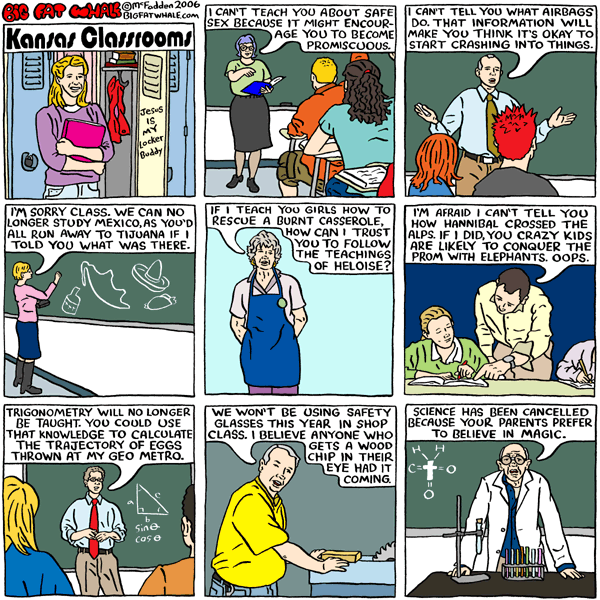
One Page Comic 'We Can't Teach You This Because....'

Not bad. Here.

Nice Doonsebury on Intelligent Design

here

Highly Recommended Paper on Hierarchical Temporal Memory

If you're interested in AI, or just more generally, in the ways in which computers can be applied, I'd highly recommend this white paper (PDF, HTML-sans-diagrams) about the Hierachical Temporal Memory (HTM) technology being developed by Jeff Hawkin's research company, Numenta. I think it's a real step forwards.

I think the name 'Hierarchical Temporal Memory' gives the mistaken impression it's just a storage technology. But it's not really. It's really a generic mechanism for learning and predicting causes. Specifically, a hierachy of causes. The reason they refer to it as a memory is that the system encodes a memory that is, in effect, of the sorts of causes it has come across before, which it uses as part of its prediction. The significance of what it does is explained in the paper.

What HTMs actually are is a theory of the general functioning of the neocortex. Neocortex seems to provide such a generic mechanisms for learning and predicting across hierachies of causes.

I've spoken earlier about Steve Grand's excellent book Growing Up With Lucy, which is actually a very similar theory of how the neocortex works. The thing about this paper is that it goes more into concrete details of how the system works.

If you're interested in knowing who the people behind HTMs are:

The founders of Numenta are Jeff Hawkins, Donna Dubinsky and Dileep George. Hawkins and Dubinsky were co-founders of Palm Computing and Handspring and have worked together for a dozen years. Hawkins is known as the architect of mobile computing products such as the PalmPilot and the Treo smartphone. Dubinsky was CEO of Palm and Handspring, and is CEO of Numenta. Dileep George has worked with Hawkins at the Redwood Neuroscience Institute since the summer of 2003 and has extended and formalized Hawkins' theory of the neocortex.[source]

Saturday, July 01, 2006

Ultrasound Tool Developed For Regrowing Teeth and Bones

According to this story, some Canadian researchers have developed a tool for regrowing teeth and bone (a bit more detailed info here).

It is still at the prototype stage, but the trio expects to commercialize it within two years, Chen said.

The bigger version has already received approvals from American and Canadian regulatory bodies, he noted.

Identifiers for News Stories

Just a quick thought... It would be interesting if you could subscribe to a particular news story, so that you could automatically receive any followups to it.

So if you subscribed to a news story about someone being injured, you could receive followups about how they ended up fairing. In the current dynamics, follow ups tend to be buried under 'the news of the day', or are simply not done.

This would require some sort of identification of a particular story. That in itself would be interesting, if different parties reporting on it were using the same identifier.

I'm not saying that this would be a click of the fingers to get right, but I think that it could be worked out. I think it's pretty inevitable that things will evolve towards making the information we deal with more explicit, and this could be a place for a small step -- of many such possible places -- towards that.

Tuesday, June 27, 2006

Extreme Hammocking

Extreme Hammocking pics

Sunday, June 11, 2006

Confusing an instance for the concept - in review of memes book

The other day I came across this negative review of the book on memes ‘Thought Contagion’ by Aaron Lynch. The review's main criticism is this: the book is far too freewheeling with the concept of memes, using it make fairly superficial explanations of anything and everything.

But the problem is, while the criticism is really about the book, and how it uses the concept of memes, the review presents the criticism as being of the notion of memes itself. But the review doesn't actually present any criticism of the notion of memes, beyond problems with the nature of Lynch’s particular account of them.

In other words, what the review does is confuse a particular theory of memes with the notion of memes. You could say that it's confusing an instance of a concept for the concept itself. I believe this kind of mistake is very common, though showing other examples is something for later.

Tuesday, June 06, 2006

Article About Somewhat-Complex Ecosystem Developed Within Second Life

Article about a somewhat-complex ecosystem someone has made for the game Second Life.

Monday, June 05, 2006

Michael Bloomberg's Speech, Defending Scientific Values

New York City major Michael Bloomberg's address to graduates of Johns Hopkins University School of Medicine, as mentioned in Slashdot. You wouldn't normally expect, from a political person like him, such strong defence of the scientific principles of evidence and truth.

Article on Music Recommendation Engines

After seeing this Slasdot article on music recommendation engines, I've just signed up with last.fm, which seems pretty good (see the article for info on the differnet options available). I wasn't really aware of these sorts of sites, and I haven't started playing with it yet, but it sounds pretty cool.

Thursday, June 01, 2006

Robert Winston: the virtues of animal testing

A sensible-sounding article by Robert Winston. "Instead of being cowed by activists, scientists should trumpet the virtues of animal testing".

Matt Inglot's on Not Having a "Real Job"

[Update: the post can now be accessed here]

Matt Inglot shares a short anecdote about people's attitudes towards an unconventional career path:

While I was busy learning about business in an unconventional way and doing so from the comfort of home, my friends were also in the process of getting their first jobs. I was then introduced to a mentality that I didn’t really understand, and still don’t. The moment they joined the workforce flipping burgers and stocking shelves they became really helpful in telling me that I should also get a job. When I insisted that I did have a job and enjoyed it very much the response was always “that’s not a real job Matt”.

...

The fear of somebody doing something different, something with an unsure ending, is so strongly built into society that virtually all the high schoolers I knew instinctively tried to tell me that I was on the wrong path. In reality they were scared, and trying to re-assure each other as a flock that their normal path was indeed the correct one.
I must admit that the way people prefix things with "real"--like "real job", "real music", "real world" etc etc--irritates me. It's usually a lazy, hollow way of criticising the things that are supposedly not "real" instances of the thing.

Wednesday, May 10, 2006

Research Relating to Miconceptions About Girls and Bullying

Misconceptions can be bad, because they can lead people to overlook real problems. The Daily Mail reports on some recent research that corrects some common-seeming miconceptions about girls and bullying.

Avoiding Conflation of Signifier With Signified By Understanding Why It Signifies

Seeing signifiers as the signified is, sadly, a widespread "cognitive pathology".

Understanding why the item may act as a signifier for the other item is a good way to avoid this problem. It makes you decouple the items from each other.

And since signification is invariably context-sensitive, understanding why the signification occurs allows you to appreciate that it isn't always the case and appreciate when it does and does not apply.

(I have a strong suspicion that always considering 'why' is the key to developing effective thinking skills, but that's an idea that I need to develop more).

Video of Tennis Game Using New Nintendo Motion-Sensing Controller

Aside from Freecell (a card game) on my laptop, I haven't played computer games for years. Mainly this is because I haven't had time for it, but I also haven't been that interested in the games out there (though World of Warcraft looks cool).

Now, for the first time in years, I'm excited about an upcoming computer games thing: the Nintendo Wii (formerly called the 'Nintendo Revolution'), with it's cool motion-sensing controller.

There's a general article about it here, and a video clip of a tennis game for it here. I think that looks really cool.

As Gizmodo says:

Those of you out there who doubt that the Nintendo Wii’s Remote is going to be the best thing ever: If you’re still drinking the total haterade after watching this video of ... playing Wii tennis at Nintendo’s pre-E3 press conference this afternoon, there is no love in your shrivelled heart and not even unicorns and rainbows can save you now.

Dharmesh Shah on Good and Bad Sorts of Simplicity

Dharmesh Shah has written two good articles considering the view that software should be as simple as possible. The articles try to clarify what sorts of simplicity are good and what kinds aren't. (The articles are a response to the 37signals book Getting Real, which is big on the simple-as-possible thing).

The first article argues that software, being focused for users, has to meet their needs, and simply providing the minimal set of features can bring them up short.

The second article is a bit of an elaboration on that. It argues that while software should be made simpler by being 'opinionated' and deciding 'the little details so your customers don't have to' it shouldn't go too far and become 'stubborn' -- stubborn software is not only opinionated but it is inflexible and doesn't provide users the ability to configure the software to their preferences.


This stuff is related to what I've written on the nature of 'simplicity' and 'complexity':

(1) Sketching on Simplicity As Qualitative Perceptual Concept
(2) Notes on What Qualitative Perceptual Concepts Are
(3) Complexity as Qualitative Perceptual Concept
(5) Quick Drafting on Tradeoffs Between Local and Global Simplicity/Complexity
(6) Factors in Tool Complexity/Simplicity: Viewing Value as Additive
(7) Factors in Tool Complexity/Simplicity: Vertical- and Horizontal- Features
(8) Initial- and Standing- Simplicity/Complexity
I also noted down this this comment by Linus Torvalds on this matter of oversimplification.

Tuesday, May 09, 2006

Forbes's List of 15 Ways to Live Longer

Forbes has a list of 15 ways to live longer. Mostly usual ones you'd expect like get a pet, be optimistic etc, though a few things I found of interest:

#5 Get a VAP

It's estimated that about half of the people with heart disease--the No. 1 killer in the U.S.--have normal cholesterol levels, which raises serious doubt about the ability of traditional cholesterol tests to detect risk. But more advanced cholesterol tests, like the VAP test, made by the Birmingham, Ala.-based lab Atherotech, may remedy that. VAP measures important metrics that traditional tests miss. Regular tests only detect half of the people with heart disease, while the VAP has been shown to detect 90% of heart disease patients. That's important because lipid abnormalities can most often be rectified with medication and dietary changes. And the sooner you start making changes, the better.
Also, intresting to see this much importance put on stress:
"I think stress kills more people than just about anything else," says Dr. David Fein, medical Director at Princeton Longevity Center in New Jersey.

Taxibuses

Sounds good, if it works out in practice. As the name suggests, like a mix between a bus and a taxi. You just call up and it will come around and pick you up. Leverages tracking and scheduling technology to best allocate the requests to taxibuses:

GT promises that their system would guarantee 3-minute rapid response based upon computerized itineraries in each taxibus that instantaneously updates upon each new ride request. The computers also have GPS technology that directs drivers to their destination and adjusts continuously to accomodate new circumstances.

'Deliberate Practice' is Where Skill/Talent Comes From Says Recent Research

The New York Times reports on some recent research, by Anders Ericsson at Florida State University, into where skill/talent comes from:

Their work, compiled in the "Cambridge Handbook of Expertise and Expert Performance," a 900-page academic book that will be published next month, makes a rather startling assertion: the trait we commonly call talent is highly overrated. Or, put another way, expert performers — whether in memory or surgery, ballet or computer programming — are nearly always made, not born. And yes, practice does make perfect. These may be the sort of clichés that parents are fond of whispering to their children. But these particular clichés just happen to be true.
They see improvement as the result of what they call deliberate practice:
Deliberate practice entails more than simply repeating a task — playing a C-minor scale 100 times, for instance, or hitting tennis serves until your shoulder pops out of its socket. Rather, it involves setting specific goals, obtaining immediate feedback and concentrating as much on technique as on outcome.

Thursday, May 04, 2006

Article on Distinction Between Freedom and Democracy

An interesting article on the distinction between freedom and democracy -- how will of the majority can work against important freedoms -- and putting this in the context of the Iraq situation.

Wednesday, April 26, 2006

Criticisms of a Guardian Article on Technologies Affects on our Brains

The Guardian has an article indicting the effect of new technologies on our brains -- but I think it's criticisms are extremely trite. The article contains fourteen paragraphs, but the actual criticisms are only given three sentences (quoted below) and are not given any justification.

...the process of traditional book-reading, which involves following an author through a series of interconnected steps in a logical fashion. We read other narratives and compare them, and so "build up a conceptual framework that enables us to evaluate further journeys... One might argue that this is the basis of education ... It is the building up of a personalised conceptual framework, where we can relate incoming information to what we know already. We can place an isolated fact in a context that gives it significance." Traditional education, she says, enables us to "turn information into knowledge."
...
The flickering up and flashing away again of multimedia images do not allow those connections, and therefore the context, to build up. Instant yuk or wow factors take over. Memory, once built up in a verbal and reading culture, matters less when everything can be summoned at the touch of a button (or, soon, with voice recognition, by merely speaking).
Why do these images not allow these connections? No reason is given.

Does memory really matter less? No justification is given for the claim. Does being able to look up facts really mean that we remember things less? It's not obvious that it should -- for the memorisation processes are pretty unconscious, and memorisation involves understanding of the content.

Perhaps what the ability to look things up gives us is just more leverage?

And why are there no mentions of how technology may be increasing our cognitive powers? For example, the increasing sophistication of the plots of television programs, requiring greater memory and connecting the dots?

Steve Pavlina on How to Wake Up Immediately When Your Alarm Goes Off

Steve Pavlina gives some sensible sounding advice on how to get up immediately when your alarm goes off. The article is a bit long-winded, but the point is basically this:

Even though you really would like to get up when the alarm goes off, trying to convince yourself of this at the time just doesn't work very well. You're tired, you don't feel like getting up -- and your brain is just too foggy to effectively fight that.

Instead, he suggests forgetting about your conscious mind and training your subconscious mind to get you out of bed when the alarm goes off, by the only way it can be trained: through practice. So practice lying in bed and jumping up as soon as the alarm goes off, and if you practice it enough it'll become automatic.

Thursday, April 20, 2006

Paul Graham on Discarding the Assumption that it's all About Us

[Update: the blog post can now be found here]

In this post, Paul Graham starts writing about what drives bloggers to blog but ends up talking about the following. It's a very good read.

...The history of ideas since people first started writing them down is a history of gradually discarding the assumption that it's all about us.

...The idea that we're the center of things is difficult to discard.

...So if you want to discover things that have been overlooked till now, one really good place to look is in our blind spot: in our natural, naive belief that it's all about us. And expect to encounter ferocious opposition if you do.
In relation to my PhD research, I actually think that the reason people haven't been able to understand information is because of this kind of thing, more specifically taking certain elements of their perception for granted.

This has to do with what I wrote the other day about people not being able to understand information because they are looking for a declarative understanding of it rather than a fully imperative one. A fully imperative one forces you to fully take your perception out of the picture.

Wednesday, April 19, 2006

Steve Grand: Moving AI out of its infancy: Changing our Preconceptions

[Update: the article can now be found here]

An excellent article by Steve Grand, on where he thinks AI needs to go. It's like a summary of the main points in his book "Growing Up With Lucy".

The main points he makes are:

  • The purpose of the brain is to compensate for all the time it takes for the nerve signals to travel to it and back again.
  • Brains don’t make decisions
  • Brains perform coordinate transforms
  • Nervous tissue is a new state of matter
  • The more complex a robot is, the easier it is to make progress

Things We're Poor at Imagining, Concerning Higher-Rung Skills

Another bit of sketching on laddered skills...

There are some things we are poor at imagining, concerning higher-rung skills.


Our ability to develop a higher-rung skill.

We often ask ourselves the question: could I develop my skills beyond their current level to a higher-rung? Our nature seems to be such that, by default, we feel that we can't.

I think this is a flaw in our nature. It's very difficult to really know that you can't develop the skill. All you can really do is work at it, and keep on working at it -- and invariably, if you do this, you will end up being able to do it.

The lesson is: expect to feel that it's not possible, and take no notice of it.

Why do we think we can't? I think a lot of the cause is that we can't see how we could develop them further. But the thing is, you can't see how it happens. It just does, given the appropriate practice.

I think it's also, in part, because we tend to think if something isn't possible at present then that's because it is not possible, full stop. It's clear, if you look at history, that people always tend to think this. Human flight? Ridiculous! Being able to instantaneously talk to someone on the otherside of the world. Impossible! etc etc.


Whether still-higher rungs exist.

Do any higher rungs exist, beyond the highest level of skills that people currently have? This is really just a variation on the previous item.

We like to think we can tell, and we tend to always think the answer is 'no', but it's very difficult to actually rule out the existence of higher-rungs.

Sure, we may not be able to see how there are any, and at present no one may be able to go futher, but these are poor indicators of the actual nature of the task and what is possible.

An example I like is the case of ollies in skateboarding. That's when the skater is skating along and jumps into the air with the board stuck to their feet - or at least, that's how it looks.

Before the ollie was invented, if you had asked people whether they thought such as thing was possible, I think they would have said: no, it's not possible, it can't be done; none of the experts can do it; I can't see any way that it could be possible.

But that's the thing: you can't imagine it. I doubt the invetor created it by thinking of the idea and then going out and praticing it. It probably evolved out of something they once did, perhaps by acident.


What a higher-rung skill enables

We seem to think that we imagine correctly about what a higher-rung skill, that we don't yet have, would enable us to do. We seem to think that what's required for imagining it is the appropriate amount of effort.

While it may be possible to do in some cases, the general case is simply not possible. The only way is to actually have the skill and see what you can do with it. You can't imagine what would happen if you had the skill.

Essentially, being able to do that would require that you could properly simulate having the skill - and that's more complicated than just having the skill, which you don't.

Tuesday, April 18, 2006

On the Development of Skills from Conscious to Unconscious and Habitual

Just noting a few more things related to laddered skills.

It's not enough to know what a skill involves. It's not enough to put in a lot of effort and think you'll suddenly be able to do it. A skill has to be developed through practice, and this takes time.

Over time, the performance of skills becomes more unconscious and habitual, but their initial development takes a lot of conscious effort.

Not only in actually 'performing' the skill, but to make sure you think of doing it at the required times.

Part of the effort may also involve overriding existing habitual skills occupying the same territory. New skills aren't added into a vaccumm.

What I hope to get into next is a discussion of why cognitive abilities are laddered skills, and how this viewpoint effects how we think should think about them.

The Computer Revolution as a Switch to Imperative Descriptions

In their book "The Structure and Interpretation of Computer Programs", Abelson and Sussman write:

The computer revolution is a revolution in the way we think and in the way we express what we think. The essence of this change is the emergence of what might best be called procedural epistemology--the study of the structure of knowledge from an imperative point of view, as opposed to the more declarative point of view taken by classical mathematical subjects.
I agree, and I'd say the declarative point of view is common to a lot more than just classical mathematics. I think it's an important advance, but one that most people haven't caught up on yet. For example, in the context of my PhD research, I think the reason people get stuck when they try to understand information is because they're stuck in declarative approaches to it.


I came across this quote in Quotations for Learning and Programming.

Jon Udell on Freeing up the Medicatl Information Monopoly

Jon Udell writes about the limitations caused by the medical professions monopoly on medical information, and what technology can and is doing to free it up.

Pacific "Cargo Cults" Still Going

The Telegraph reports:

Followers of a South Pacific cult, who worship a mythical Second World War American serviceman they hope will one day return bearing riches, believe that their prayers have been answered.

Monday, April 17, 2006

Scott Adams on Respecting the Beliefs of Others

Author of the Dilbert comic, Scott Adams, writes about respecting the beliefs of others:

I also wonder if showing respect for all beliefs is causing more problems than it’s avoiding. The only thing that keeps most people from acting on their absurd beliefs is the fear that other people will treat them like frickin’ retards. Mockery is an important social tool for squelching stupidity. At least that’s what I tell people after I mock them. Or to put it another way, I’ve never seen anyone change his mind because of the power of a superior argument or the acquisition of new facts. But I’ve seen plenty of people change behavior to avoid being mocked.

Sunday, April 16, 2006

On the Character of Lower- and Higher-rung Skill-Sets

Some more details concerning laddered skills.

What would we expect to see in lower-rung skill sets? We might expect to find an incomplete set of capabilities, some of which are simply ineffective.

What about higher-rung skill sets? We might expect that they replace ineffective lower-rung skills and fill in the gaps.

But I think this is wrong. Lower-rung skills tend to provide a more complete set of capabilities than we would expect. But what is 'lower' about them is that they provide a simplified set of capabilities, painted in broader-brushstrokes.

And what higher-rung skills tend to do is not simply add or replace, but refine aspects of those broad-brushstrokes.

It's also worth noting that even if a particular rung provides some less refined capability, this may be beneficial in some circumstances for pragmatic reasons. So 'higher-rung' does not simply mean better.

Still to come, some of the reasons I'm talking about laddered skills...

Saturday, April 15, 2006

'Science vs. Norse Mythology' comic

Not bad.

Some Interesting Discoveries About Human Perception's Ability to Gleam Information

EurkAlert reports:

Faces tell the stories in UC Riverside Professor Larry Rosenblum's ecological listening lab, as volunteer test subjects show that they can "read" unheard speech -- not just from lips, but from the simple movements of dots placed on lips, teeth and tongue.

They can also recognize people's voices just from seeing their faces, and vice versa, and seem to be able to distinguish among a variety of rooms on campus just from their echoes.

Lancet Calls For Proper Research Using LSD, ecstacy etc

The Guardian reports:

"Use more psychedelic drugs," is not advice you would expect from your GP, but that is the call from an influential US medical journal to researchers.

An editorial in the Lancet says that the "demonisation of psychedelic drugs as a social evil" has stifled vital medical research that would lead to a better understanding of the brain and better treatments for conditions such as depression.

Thursday, April 13, 2006

Laddered Skills

Skills are 'laddered'. Your capabilities develop through several stages, or rungs.

The skills we develop build upon those we already have. Lower-rung skills are pre-requisites for developing higher-rung skills.

You can't avoid these dependencies, even if there's wide variation in the way that you learn the skills. Wide variation in learning styles does not equal complete freedom in the order that we can obtain the skills.

There doesn't have to be just a single ladder leading up to mastery of a skill, however.

You can't avoid these dependencies and, without obtaining the intermediate skills, leapfrog more than one rung from your current position, no matter how much you might grit your teeth and exert effort. Effort can't leapfrog over dependencies. And remember that it takes time to develop each skill.

More on laddered skills to come.

Wednesday, April 12, 2006

First-rung Conceptualisation Frameworks: Essence-based Things and Social/Aesthetic Interpretation

Quick, incomplete sketching...

I’m going to do an oh-so-terrible thing and speak of the human mind if it had a certain structure to it, and worse, that that structure is less than perfect. I know, I know, I am the devil, but I would rather face an imperfect reality and try to understand it so I can try and do something about it.

I think that we ‘naturally’ have certain means, or tools, for conceptualising the world. We only supplant these tools when our culture has accumulated a fairly large amount of knowledge about the world, and we have ourselves learnt a fairly large amount of that. (I'll explain the 'first-rung' terminology used in the title later on in another post).

I think the main tools, or frameworks, are the following. Seeing the world in terms of 'things', where each thing is of a certain type. Being of a certain type means that it has some set characteristics. Characteristics include intentions, functions and properties.

Characteristics apply to the thing as a whole. They don’t apply only to aspects of it, and they don’t apply only contextually to it. They are essences - they are just something that the thing has, and the only explanation of this can be because of other intentions, functions or properties of the thing. The thing can not normally have contradictory characteristics.

Intention is seen as the primary tool available for explaining why things have happened.

There are strong social and ‘aesthetic’ elements to our conceptualisation. Things and situations are interpreted in these ways. As part of the ‘aesthetic’ element, things and situations always have a property of good or bad (to some degree), reflecting our approval/dissaproval of them. The social element includes notions such as power, hierarchical position and fairnes/unfairness.

The problem is that the world can not be very well understood in these terms, but if those are the only tools we have, we will squash our view of other situation into those terms.

Of course, the hard thing is in demonstrating that these actually are the primary tools for conceptualising things, and in showing that they are not very good for conceptualising the world. But all I wanted to do in this post is sketch out some basic details.

Graphically Representing Perceptual Attention-Levels

Here's an idea. I wonder if you could graphically represent the differing levels of perceptual attention we give to things in our environment.

I'm imagining something like this. It could display an animated scene of a person is walking down the street. The viewer would see things from just behind the person, so they are seeing pretty much the same view that person does.

But rather than the scene looking like normal, the appearance of items in it would be modified in order to show how much attention the person is giving to them. So the more attention being given to an item, the bolder and brigher the item would be displayed, and the less attention being given to it, the more muted and washed out it would be displayed.

Items being given low-levels of attention might be grouped together, ignoring the specific items within the group. Like say there's a store front containing a window containing a display. As the person walks past it, they might just treat the whole store-front as a single unit. So perhaps a border could be drawn around it. And perhaps such groupings could be labelled with the category the person's perception puts them in, say 'store-front' or 'building detail'.

The view could rotate around to track what the person is looking at, and the scene would dynamically update to show the varying attention-levels being given to things.

Attention-levels would cahnges as the person is walking along, as things happen within the environment (like a car drives past), and as the person undertakes actions (like talking to someone on the phone).

Say they get a call on their mobile. If the phone is in their pocket, then the calling sound could create bright radiating lines eminating from their pocket.

And as they go to take it out and start talking to the person, the amount of attention given to other things in their environment could fade. And the words coming out of the phone, and their words, could be shown on the screen, with a level of brightness indicating the amount of attention given to them.

You could show situations where there are 'significant' things that are happening, but which the person doesn't notice because the area where it's happening might not being given much attention.

Like someone being mugged on the other side of the street, which they don't notice because they're busy talking on the phone and watching a sports car driving past.

It would be interesting to see how well such a graphical representation of attention-levels could be implemented. And, if it could be implemented well, whether it could be used to useful effect in simulations or computer games.

Warning Sign Number 7

Physicist Robert L. Park outlines 'The Seven Warning Signs of Bogus Science'. To be honest, I wasn't that impressed, but I did want to note the final one:

7. The discoverer must propose new laws of nature to explain an observation. A new law of nature, invoked to explain some extraordinary result, must not conflict with what is already known. If we must change existing laws of nature or propose new laws to account for an observation, it is almost certainly wrong.
It is interesting to note that we are quite happy to violate existing laws when it comes to beliefs that seem "common sense" or which we consider to be matters of philosophy (as if reality contained this separate category of phenomena).

Like with the concept of information. Most people seem to consider it to be some kind of, as yet unexplained, intangible thing. Some intangible thing that interacts with the ordinary physical world in some unknown way. And yet, virtually no-one seems to bat an eyelid about this.

Alcohol 2.0 - Minus the Bad Side-effects

NewScientist reports on the idea of creating:

...a cocktail of drugs that mimics the pleasurable effects of alcohol without the downsides. The idea is only on the drawing board, but there is no scientific reason why it could not be made right now, says psychopharmacologist David Nutt of the University of Bristol in the UK.

Tuesday, April 11, 2006

Feeling and Intuition, Embedded in Reason

Quick sketching.

Sometimes reason works best, sometimes feeling and intuition does. We have to learn what works best in what sorts of situations.

When faced with a situation where we could choose between them, feeling/intuition does not seem to be a suitable guide.

We have to consicously consider whether which is more appropriate, and this is a matter of reason.

And this means that, while feeling and intuition are important, they always need to be embedded in reason.

Mother dies after 911 call is treated as prank

MSNBC reports:

DETROIT - A 5-year-old boy called 911 to report that his mother had collapsed in their apartment, but an operator told him he should not be playing on the phone, and she died before help arrived.

Jurors Biased by Animated Recreations Used in Courtrooms

EurekAlert reports:

Roese and colleagues suggest that by viewing a computer-animated re-creation of an event, a person's confidence is heightened -- but not necessarily accurately. An animation, they say, provides movement as reconstructed by a prosecution, plaintiff or defense witness to reconfirm or heighten a jurist's hindsight feeling that "I knew it all along."

Tuesday, April 04, 2006

Music I Like: You Know You're Right by Nirvana

For a while I've been wanting to write a bit on music I like, but it's one of those things I never get around to.

So in a more bottom-up spirit, I thought I'd start small, and try and do it one song at a time.

This time it's Nirvana's You Know You're Right (Wikipedia entry).

Posthumus releases can be a bit of a worry -- are they just trying to dredge up any old thing they can? -- but I was quite pleasantly surprised by this song. If you don't know its background, it was recorded in 93 or 94 but wasn't released until almost ten years later.

The song is pretty classic Nirvana, combining power with melody, and 'you know you're right' is a nice lyric.

The verse music is also a little unique for them, having a sound that I can only think of describing as a little funky, having more bass and more of a looping structure to it.

And who else but Kurt Cobain could half-sing, half-scream a couple of drawn out utterances of 'pain' and make such a great-sounding chorus?

Things You Don't Understand Always Seem Intangible

In an excellent essay on software patents, Paul Graham makes the point that things "always seem intangible when you don't understand them". I agree 100%. Why do I bring this up? Because 'information', which my PhD is about, is something that everyone thinks is intangible, and I don't think it is -- and I think the reason it appears intangible is the one Graham cites.

This is the relevant part of Graham's article:

Experts can implement, but they can't design. Or rather, expertise in implementation is the only kind most people, including the experts themselves, can measure.
In a footnote to this he says
Design ability is so hard to measure that you can't even trust the design world's internal standards. You can't assume that someone with a degree in design is any good at design, or that an eminent designer is any better than his peers. If that worked, any company could build products as good as Apple's just by hiring sufficiently qualified designers.
Back in the main text he goes on to say:
But design is a definite skill. It's not just an airy intangible. Things always seem intangible when you don't understand them. Electricity seemed an airy intangible to most people in 1800. Who knew there was so much to know about it? So it is with design. Some people are good at it and some people are bad at it, and there's something very tangible they're good or bad at.

Monday, April 03, 2006

Scientific and Technological Development = Removal of Constraints

Some fairly quick sketching...


I think that scientific, and particularly technological, development can be seen as the removal of constraints.

By that, I'm not trying to make some broad rhetorical statement about science and technology giving humanity greater freedom. What I mean is something more specific. I'll talk about technological development first, then consider the case with science.

When you want to undertake a task, such as being able to communicate with others, there are various constraints that apply.

When communicating by unaided voice, you're constrained to communicating to those within earshot.

Communication technologies remove constraints (and can also add constraints of course). For example, a telephone removes the distance constraint to some extent, and SMS and email remove the constraint that the receiver is currently available to take your communication.

There is a kind of platonic ideal for each type of task, free of all of the possible constraints that could apply to it. Constraints restrict this platonic ideal.

I'm not suggesting that the platonic ideal is a real thing, but just an ideal that we might be able to get very close to but never reach.

For communication, it is being able to instantaneously, perfectly and effortlessly transmit your information to anybody at any time, or something along those lines.

As a particular type of technology develops, constraints are relaxed or removed and, as a whole, it moves towards the ideal.

I think the utility of this picture of technological development is that it gives you a good way to think about future technological development.

You can think about what the unconstrained version of the task would be like, and thus what the various types of constraints are, and thus the ways that the current state of the technology can move, and what it could end up like.

I get the impression that many people see it as a mystery as to where 'technology could go next'. But the answer is: look at what constraints there are and could potentially be removed.

The story with scientific development is similar - the more you understand about the world, the more you can reason about it and the more powerful you technological capabilities can become.

Ultimately, it's about realising our intentions and removing potential constraints to that.

.

Related: The value of greater convenience at scale in technological developments. Providing greater convenience is actually a significant way of removing constraints.

Friday, March 31, 2006

Factors in Tool Complexity/Simplicity: Vertical- and Horizontal- Features

More sketching...

I think one of the reasons 'simplicity' has become such a mantra is simply that us humans aren't very good at design.

Designing well to support a task requires an accurate model of the task, of the user and so on, and I think we tend to have simplified models.

So if we do the simplest possible thing that works, there's less scope for stuffing things up.

Why aren't we so good at design? I think one reason is the following.

I think our natural tendancy is to provide capabilities or software properties by creating a specific feature(s) specifically for them. These can be called vertical features.

The problem is, because of our simplified models, our attempts to support those specific tasks end up being too simplified, and thus restrictive.

An aspect of this is that the division of labour between the user and the computer is being pushed too much in the direction of the computer. It can be more natural for the user to know what they want to do and to simply find and use the capabilities that are suitable for executing that. If too much is being explicitly handled by the computer, and the user is too railroaded, it no longer remains a simple tasks of the user translating their intentions into operations.

There are also horizontal features, which are not designed for a particular task or property, but provide generalised capabilities than can be used for it. Cut-and-paste is an example. They tend to be lower-level, simpler and more flexible.

Factors in Tool Complexity/Simplicity: Viewing Value as Additive

Some sketching...

Overengineering is one reason why software becomes too complex. What causes overengineering? One reason is having a 'more is better' kind of attitude, seeing value as an additive property, where adding a feature simply increases the system's overall value.

This sort of attitude appears in all sorts of design. In music, people overengineer in this fashion when they try to make something better simply by adding more sounds. In cooking, they do it when they try to add more flavour to the dish by adding more flavours. And so on.

But value isn't a simple additive property, it is a contextual one. What impact will adding the feature have on the user's overall experience. What impact does it have on the software's footprint, for example?

As a contextual property, it is a perceptual one. Though we often think of complexity in terms of properties of the software, like the number of features, the organisation of the user-interface, we have to remember that it's not about these things per se, but their impact upon the user's experience. And to evaluate the impact of any one of these, we need to see how it sits in relation to any of the other items that impact upon the user's experience.

Tuesday, March 28, 2006

Late Nights and Early Mornings

On the final night at my last place, when I was moving recently, I staying up all night doing the final packing and cleaning.

I finished around dawn, and since there weren't any trains then, I decided to walk the kilometer or two to my new place.

I tend to be a night-time person, so I don't get to see that time of day that often, but I really like it. The light is warm and soft, and things feel fresh and peaceful.

I also like late at night. Like early morning, it feels more peaceful and more like like I've got everything to myself. Not that I've got anything against the daytime and having other people around, but it's just that those two times feel a bit special.

Understanding Views You Reject

a very good test, i think:

if you consider a view false
and
you don’t undersand why
it could make sense
to somebody else

then you don’t really understand that view

so is the reason you're rejecting it
only because it doesn’t make sense to you?

Thursday, March 23, 2006

Reasoning Without Assuming The Truth of Your Position

I think this is a very important skill, but sadly a fairly rare one:

Being able to reason about an issue without the implicit assumption that your position on it is true.

Otherwise, you tend to end up with a kind of circular argument in situations where you try to justify your own view or criticise others. You might present independent reasons for these claims, but in actuality, the only reason you think these reasons are true is your implicit assumption that you belief was true in the first place.

The same goes for your evaluation of other's criticism of your view.

What this comes down to is an assumption that your view is correct, and thus an empty reinforcement of that view and a blindness to anything that might contradict it.

Avoiding this requires the following. You need to be step down a level from your specific position, and see the different ways that the situation could be interpreted, and to be able to interpret different views without contamination from beliefs coming from other views. (Of course, you do need to be able to, at the appropriate times, interpret views in light of differing degrees of evidence you have at hand).

This means being able to handle greater abstraction and indirection, greater skills in being able to construct and 'passively view' and then reason about mental structures.

This is a skill they should teach in schools. It would make a big difference if everyone had it.

Wednesday, March 22, 2006

Initial- and Standing- Simplicity/Complexity

There's a distinction that was implicit in my recent post on software simplicity/complexity. It's between the initial complexity the user experiences and the complexity they experience once they have become familiar with the system.

We can call this the distinction between initial- and standing- simplicity/complexity.

The complexity the user expeiences can vary over time. If a feature is well designed then once the user is familiar with it, it may not add much additional complexity. Whereas if a feature is poorly designed, then the amount of complexity it adds can remain over time.

The complexity can vary because it is a subjective thing. It's not simply a property of the item, but has to do with our relation to it.

Monday, March 20, 2006

Us and Them on the Really Large Scale

Just a random thought: discovering life outside the earth might put our instinctive "them and us" conceptualising to good use and help us see all of humanity as more of a singular "us".

Friday, March 17, 2006

Quick Drafting on Tradeoffs Between Local and Global Simplicity/Complexity

I've spoken before (and followed-up here) about the notion of 'simplicity' and how I think people's notion of it is too, well, simplistic, and subjective. (I also gave a link to Linus Torvald's complaint about the mindless drive for simplicity in some software).

This post is about two different perspectives for assessing the simplicity/complexity of software systems, arguing that the one that is typically used is too narrow.

This post is just a very quick draft. It's the kind of thing I'd normally just write then save as a draft in blogger.. but i thought i might as well just post it anyway.

when people talk about simplicity as a desirable property of software
i think their consideration is too focused
on the small scale of a particular application
in that app, they want the core set of features used in the majority of tasks

what they don't consider as much is complexity on the global level
across all of the software they use

i think that greater simplicity at a local level can lead to greater complexity on the global level
what we might be able to do is add a bit of extra complexity at the local level that contributes to a decrease in complexity at the global level
and in fact, once it has been learnt, can lead to greater simplicity within the individual programs

this would be primarily done, I think, by finding the deeper common structure that is present across the different data, tasks and applications present, and providing explicit support for this.

i think this can be illustrated with an example.

consider cut-and-paste.

i seem to remember that, back when i just had DOS on my computer, many of the programs had no cut-and-paste feature. this made them simpler. and if all you could do was cut and paste within that application, it may have been debatable as to whether such a feature would be worth the added complexity.

but cut-and-paste is one of those features that really benefits from being able to use it across multiple applications. you can't fully appreciate its utility unless you consider things on a global scale.

and while cut-and-paste does add a certain level of complexity from the standpoint of an individual program, that complexity is ameliorated across the set of applications, because you only have to learn it once, rather than once-over for each new application.


i think the global level -- the overall experience -- is what really counts, not a blinkered view that only considers individual applications as stand-alone cases.


so what else can be done other than cut-and-paste?

here's an example. much data in systems is sets and lists. we could have an across-system, global capability for manipulating sets and lists. so, for example, set operations such as unions and differences. these would be applicable to any data in the system that is performing unions on them, getting their difference, etc. the specific program could constrain what capabilitys should be applicable to a given set of data.

i often wish I could do such things with MP3 playlists, files in directories, emails and query results in various different apps.

of course, you'd need to figure out a way to handle this in the UI (amongst other practicalities). but that's outside the scope of this post. i'm not talking about specific technical approaches for implementing this, and their feasability in the current system/infrastructure ecosystem, pluses and minus... just trying to introduce the concepts of local and global complexity and the trade-offs between them.

Beatrice Street

To follow-up my last post, I managed to find a new place -- at Beatrice Street in Taringa. It's okay for a last-minute find; the place is quite old, and a little run down, but the room is an okay size, and transport is fairly convenient.

Friday, March 03, 2006

Goodbye to Toowong's Explorer Street

You may have wondered why this blog is called Explorer Street.

Two and a half years ago, before I started the blog, I moved into a unit in Toowong, located in a street with that name, and it's where I've been living ever since. I thought the name had a nice ring to it.

I had hoped to stay here until at least the end of my PhD (probably another two years from now), but the unit is being sold and I have to move out. I really don't want to :(   I don't know yet where I'm going to, I'll have to see...

To Switch-off This Alarm Clock, You Must Solve a Simple Puzzle


"As soon as you can assemble the four puzzle pieces that are popped up into the air at your predesignated time, the thing will finally shut up." Sounds like what I need, though it'd be one of those things I'd hate myself for in the morning :-). US$52. (via Gizmodo)